Most advice says linen should billow and puddle on the floor, a look that suits a farmhouse with 10-foot ceilings. In a 450-square-foot rental, the same yardage swallows a wall. Natural linen curtains ideas for small rooms work the opposite way: slim, hung high, and chosen for how a hand actually moves them every morning.
Below are 28 ways to use undyed flax and oatmeal linen in a compact apartment, grouped by what they do for the room. Each one says why it works, who it suits, and what to watch out for.
Natural linen curtains ideas: The vision board
These first twelve are about layout and proportion. Get the rod, the width, and the length right and the fabric does the rest.
1. A rod mounted 6 inches above the window frame

Hanging the rod 6 inches above the frame, not on it, stretches the window upward and makes an 8-foot ceiling read closer to 9. The eye follows the vertical line of the linen instead of stopping at the trim.
This suits almost any room with standard 8-foot ceilings. Just don’t go higher than 4 inches below the crown molding, or the rod looks lost and the panels look too long.
2. Panels that stop half an inch off the floor
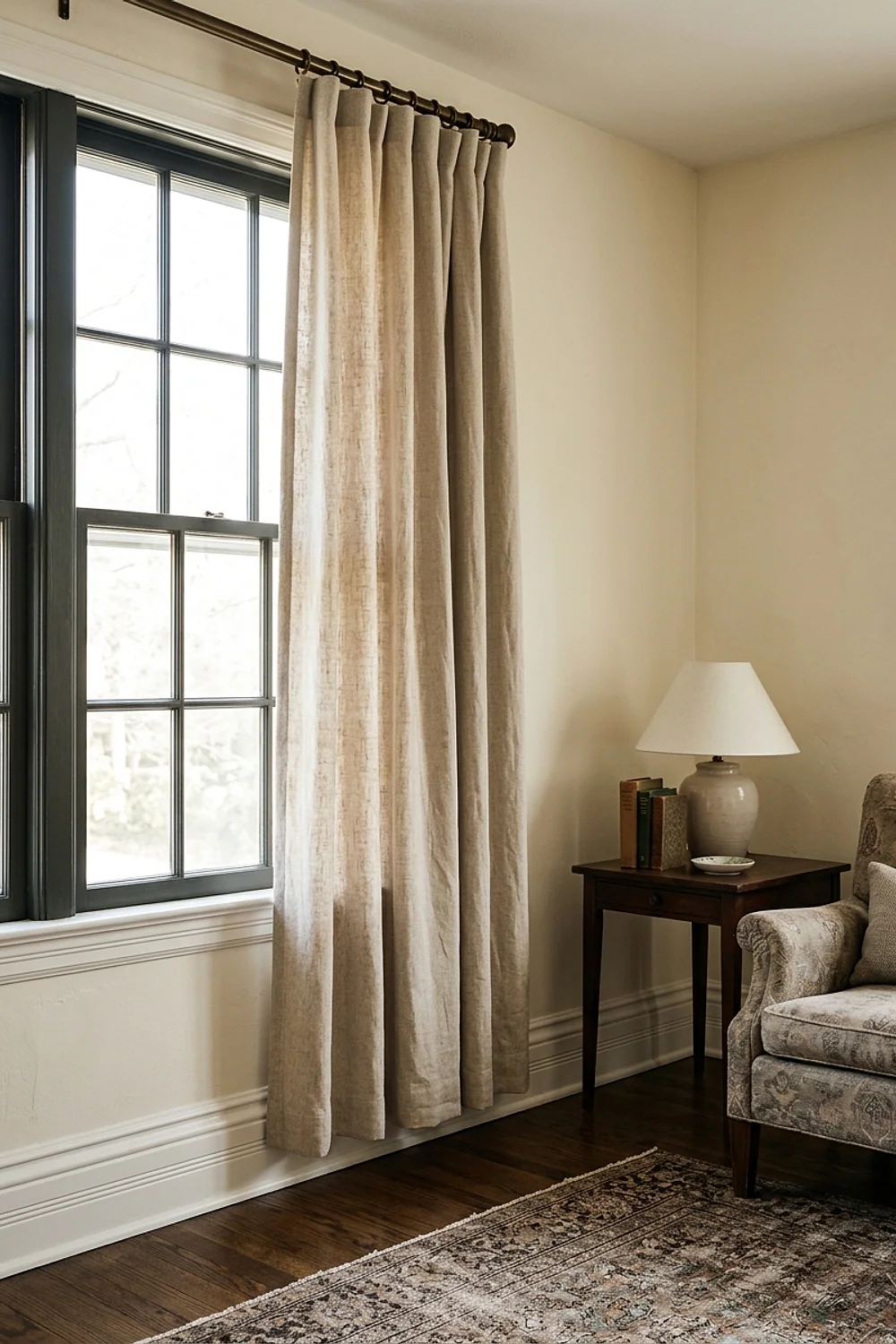
A hem that grazes the floor with a half-inch gap stays clean under a robot vacuum and never drags through a slush-wet entry. Puddled linen collects dust fast, and in a small room that dust is always at ankle height.
Measure from rod to floor after the rod is up, not before. A quarter inch of error is visible on a straight hem, so measure twice.
3. Sheer oatmeal linen at a west-facing window

Around 4pm in late October, low sun comes through a thin oatmeal weave as a soft amber wash instead of a glare on the laptop screen. The linen scatters the light across the ceiling, which brightens the whole room.
Choose this for rooms where you work or read in the afternoon. The trade-off is privacy after dark, so pair it with a roller shade if you face a neighbor.
4. Stonewashed European flax, not a linen-look polyester

Real flax gets softer and drapes lower with every wash, while polyester stays stiff and shiny. A ready-made flax panel such as Pottery Barn’s Belgian flax linen runs about $100 per panel, and lower-cost versions land near $60.
It’s worth the money on a window you see every day. Skip it in a rental you’ll leave within a year, because linen shrinks 3-5 percent on the first hot wash.
5. Clip rings with a slim pull wand

Rings that slide freely and a 30-inch acrylic wand mean you open the curtains with one hand while carrying coffee. Rod-pocket panels bind on the rod and get yanked by the hem, which wears the fabric out within a season.
A 1-inch black metal rod costs about $25 and holds the weight of two lined linen panels. Anything thinner may bow.
6. Undyed flax in a warm oatmeal tone
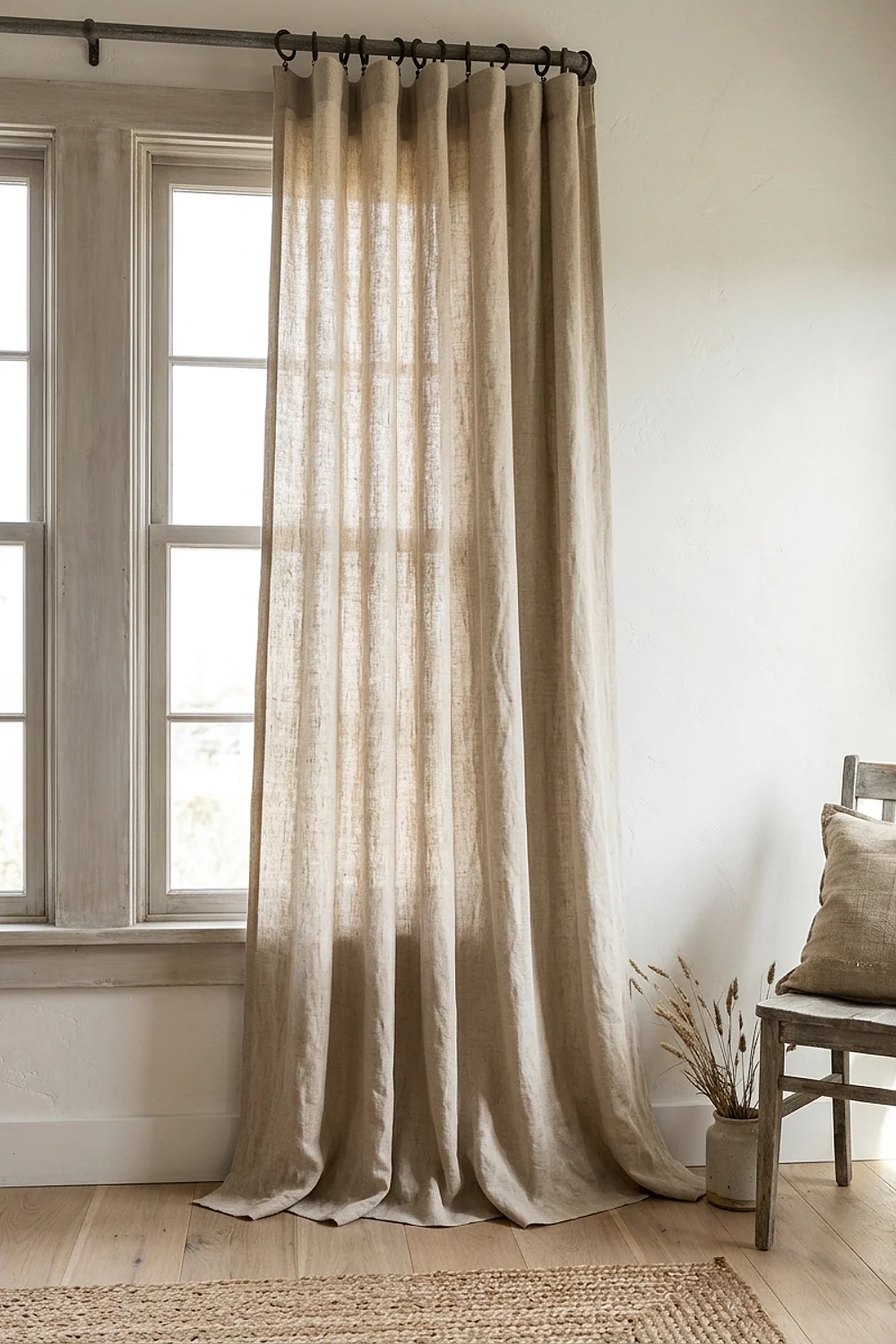
Natural linen curtains ideas that skip optical white in favor of oatmeal hide dust and hand marks, and they look right against both white paint and warm greige walls. Bright white linen reads as a bedsheet hanging in the window.
This works best in rooms that get a mix of daylight and lamplight. Hold the swatch next to your trim before buying, since oatmeal that’s too yellow clashes with cool whites.
7. Fullness cut to 1.5 times the window width

The standard 2x fullness rule eats up to 14 inches of wall on each side in a narrow studio. At 1.5x, linen still ripples but stacks tighter, leaving room for a bookshelf or a radiator beside the window.
The common mistake is buying pleated panels and then hanging them stretched flat. A flat panel with half the fabric looks cheap, so commit to the 1.5x minimum.
8. Linen layered over a white roller shade

A white roller shade handles privacy and glare at the exact moment you need them, while the linen panels stay open and soft at the sides. The shade does the functional work, so the linen can hang as pure texture. A basic cordless shade costs around $20 at most hardware stores.
This suits bedrooms and ground-floor apartments, where street-level eyes and morning sun both need managing. Mount the shade inside the frame so the curtain rod can sit freely outside it, or the panels will brush the roller and snag.
9. A wand and a hook at chest height

Comfort decides whether curtains get used. A panel you can open from the sofa arm, with the wand hanging 48 inches off the floor, gets pulled every day, and one that needs a stretch gets left shut.
Put the hook on the wall beside the window, not on the frame. Renters can use a removable adhesive hook rated for 3 pounds.
10. Spare panels rolled in a canvas bin

A 10-inch canvas cylinder bin tucked beside the sofa holds a backup pair of panels for wash day. Linen wrinkles when folded flat for weeks, so rolling it loosely saves you from ironing. Sharp fold lines set into the fibers, while a loose roll leaves only soft curves that drop out within a day of hanging.
This helps in apartments without a linen closet, where a swap pair is otherwise hard to store. Keep the bin out of a sunny window, since direct light fades undyed flax unevenly.
11. An L-shaped rod around a corner window
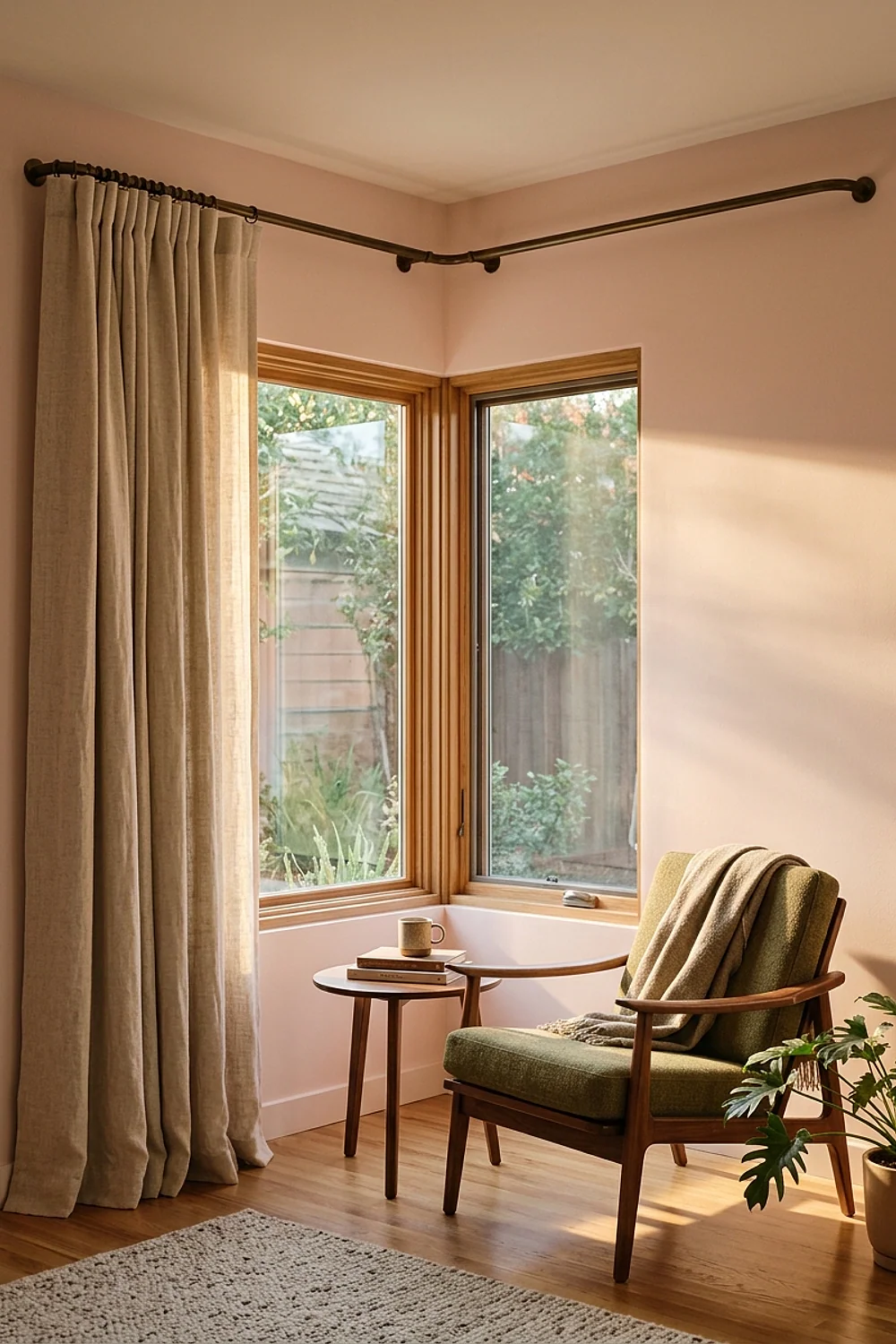
A corner window with two separate rods leaves a gap where light and drafts leak through. An L-shaped connector joint lets one continuous panel turn the corner and closes that gap. Because the fabric travels around the bend without a break, the corner reads as one clean wall of linen.
It suits dining nooks and studio corners, where morning glare or a winter draft hits the same seat every day. Check that the joint is rated for the full panel weight, because corners carry more pull than straight runs.
12. Sill-length linen behind a desk or bed

Here’s where the usual advice breaks down. Floor-length is the standard rule, but a desk or a headboard pushed against the window blocks the panel and creates a hard crease where the fabric hits the furniture.
Sill-length panels, ending 1 inch below the sill, hang clean and stay out of the way. For a window with furniture in front, shorter is more useful and honestly looks more deliberate.
Starting points for your space
Natural linen curtains ideas that stretch a room visually rely on light, color, and a few small decisions about hardware. These eight are the ones that pay off in rooms under 150 square feet.
13. A 40-percent opacity weave at a north-facing window

A loose, semi-sheer weave at 40-percent opacity lets the gray daylight through while warming it to a soft cream tone. North light is cool and flat, and a thick curtain only makes it dimmer. The open threads also soften the blue cast that cool exposures carry.
This is the pick for a gray February afternoon in a ground-floor flat. Avoid lined panels here, since they cut the light you’re already short on. Hold a sample to the glass first to judge how much privacy it really gives.
14. A linen-cotton blend with a loose slub weave

A 55 percent linen, 45 percent cotton blend has the same textured look as pure flax but resists wrinkling. The uneven slubs catch light at different angles, which gives a flat wall some depth.
It suits families and anyone who hates ironing. The downside is a slightly heavier hand, so keep panels under 54 inches wide on a standard rod.
15. A removable blackout liner snapped behind the linen
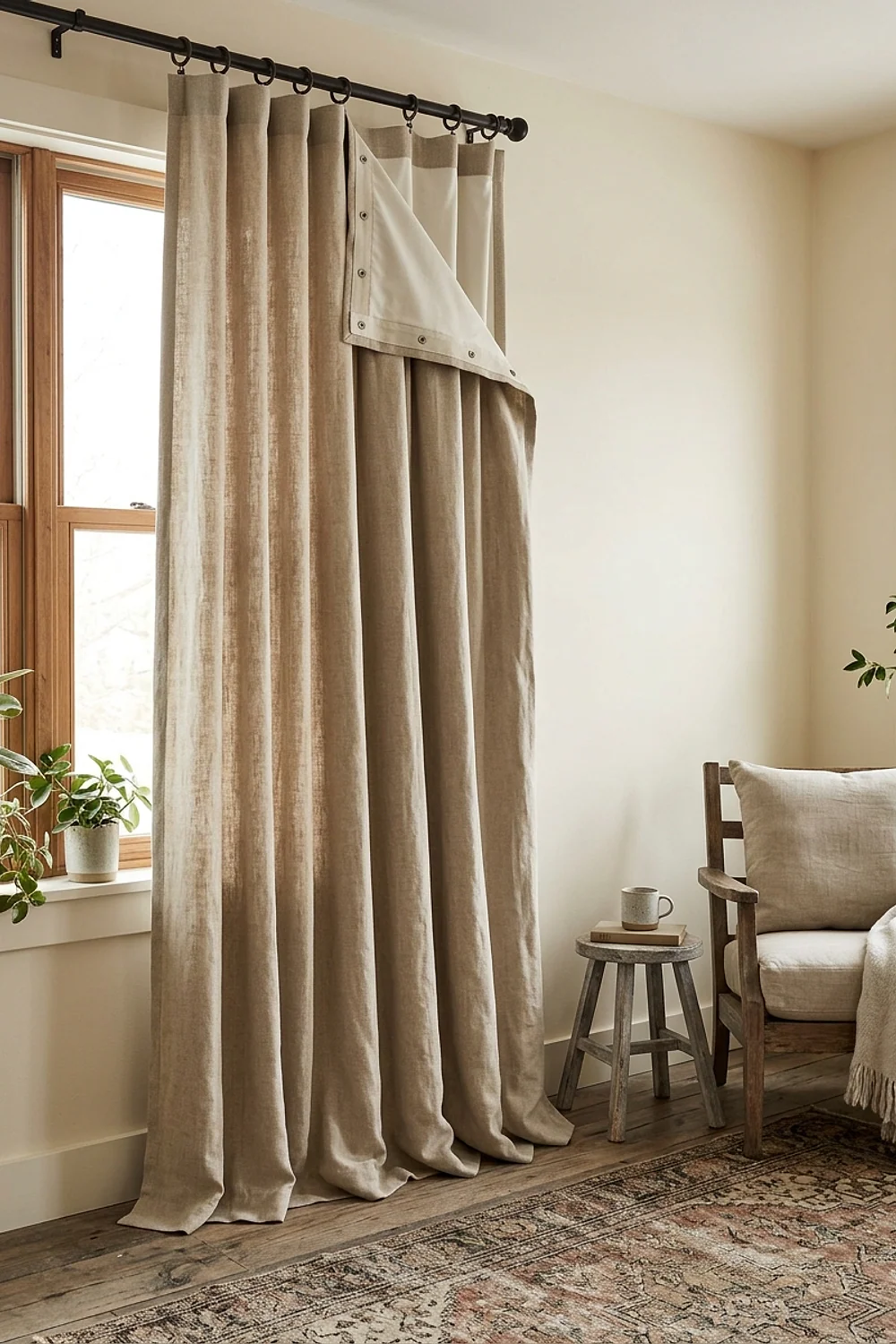
A $20 blackout liner clipped to the same rings turns day curtains into night curtains. In a studio where the bed sits near the window, that means sleeping past 6am sunrise without a second curtain.
Pick a liner in white or ivory so the back of the linen doesn’t go gray. Unclip it for summer washing, because liners shrink at different rates than flax.
16. Linen within one shade of the wall color

When curtains match the wall, the window disappears and the room seems to widen. A greige wall with oatmeal linen blends; a white wall with cream linen blends too, and the eye reads one wide surface.
This suits rooms under 120 square feet. If the wall is a dark color, the trick reverses and the linen will pop, so test a swatch first.
17. A rod wider than the frame by 8 inches each side

When the rod ends right at the frame, natural linen curtains ideas fall flat because the stacked fabric covers part of the glass. Extending the rod 8 inches past each side lets the panels sit on the wall and keeps the full window exposed.
The window looks wider and gets more daylight. The limit is wall space, so in a tight spot a 4-inch extension still helps.
18. A bare black rod with no decorative finials
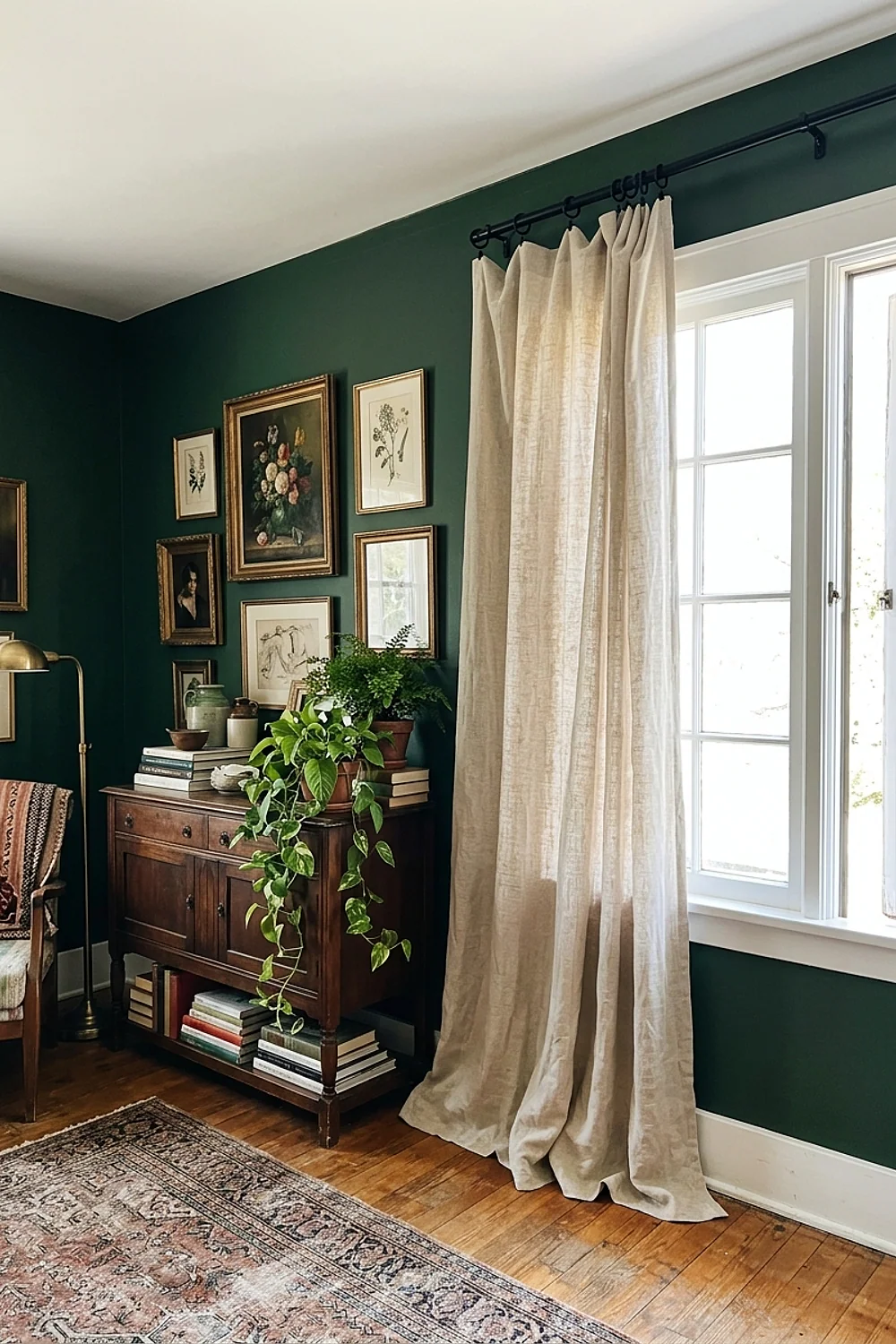
A plain matte black rod with a slim end cap recedes. Ornate brass finials draw the eye sideways and make a small window feel fussy. With the hardware nearly invisible, attention stays on the fold and slub of the linen.
Pick this for modern or Scandinavian rooms where the linen is the main texture. For traditional rooms, a wood rod in a soft walnut stain works the same way. Avoid glossy black, which catches window glare, and skip oversized end caps that bring the fuss back.
19. Panels that stack fully off the window

If a reading chair sits beside the window, a panel that stacks onto the glass blocks half the light all day. A rod extended far enough that the open linen clears the frame means you pull it back once and forget it.
Think about where your hand lands. A panel that falls naturally to the side needs no tiebacks, which saves clutter on the wall.
20. Return brackets with an S-hook for a tote bag

Return brackets curve the rod back to the wall, which seals the gap where light leaks in. A small S-hook on the bracket gives a rental with no entry closet a spot for a tote or umbrella. The bracket is already screwed to the wall, so the hook adds storage without another hole.
This suits narrow hallways and small entryways best. Keep the load under 2 pounds so the rod doesn’t tilt. A loaded bag can also drag against the panel, so hang only dry, light items.
The pieces that earn their place
The last eight ideas ask the curtain to do more than cover glass. In a small apartment, that’s often what justifies the price.
21. A ceiling track that divides bed from living area

A ceiling-mounted track with a floor-to-ceiling linen panel creates a sleeping alcove in a studio without a wall. Pulled shut at night, it gives the bed a private corner, and open by day it disappears.
It suits studios between 350 and 500 square feet. Make sure the ceiling joist can hold the track, which usually means screwing into wood, not plaster alone.
22. A 54-by-96-inch panel as a closet door

Swapping a bulky sliding door for a single 54-by-96-inch linen panel frees up the 30 inches of swing a hinged door needs. Wide panels run about $80 each and let you reach clothes with both hands.
It works well in rentals where the original door is removable. Add a weighted hem so the panel doesn’t flutter when the heating kicks on.
23. A plug-in sconce behind a sheer linen panel
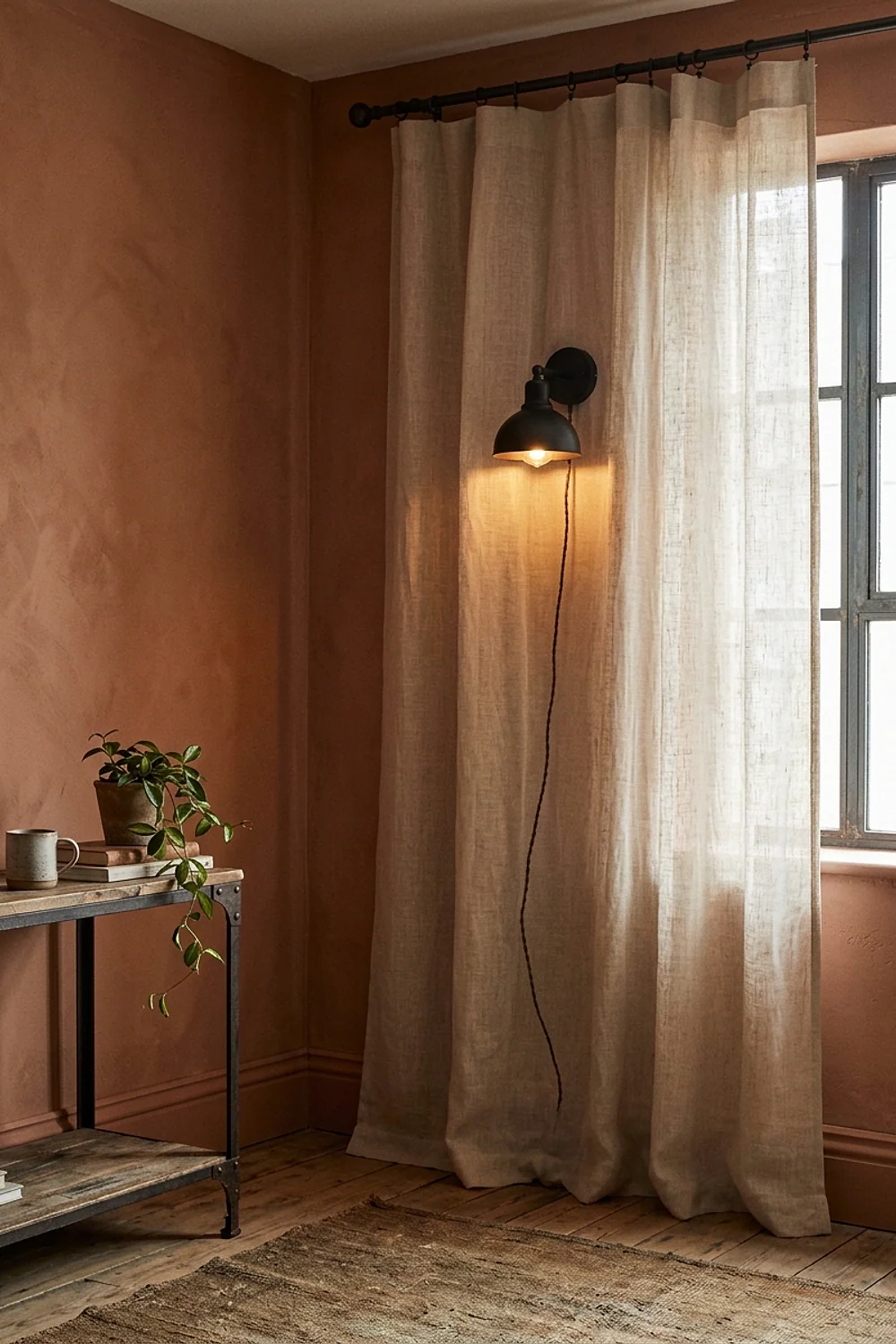
Lamps behind a sheer panel turn the window into a glowing screen at night. A plug-in sconce with a warm 2700K bulb behind oatmeal linen gives off a diffused amber light that no overhead fixture can match.
It suits bedrooms and reading nooks with no outlet nearby. Keep the bulb at least 4 inches from the fabric to avoid heat marks.
24. A pre-washed linen café curtain over open shelving

A half-height café panel on a tension rod hides messy shelves in seconds. Linen washed twice before hanging stays flat and won’t pucker after the first humid week. Pre-washing pulls out most of the shrinkage that would otherwise gather the hem unevenly in steamy rooms.
This is useful for kitchenettes and bathrooms, and for renters who cannot add doors or cabinets. Hem the panel to stop 2 inches above the lowest shelf so it doesn’t snag on jars. Cut it too long and it will drag through splashes.
25. Clip-on linen panels as a temporary closet door
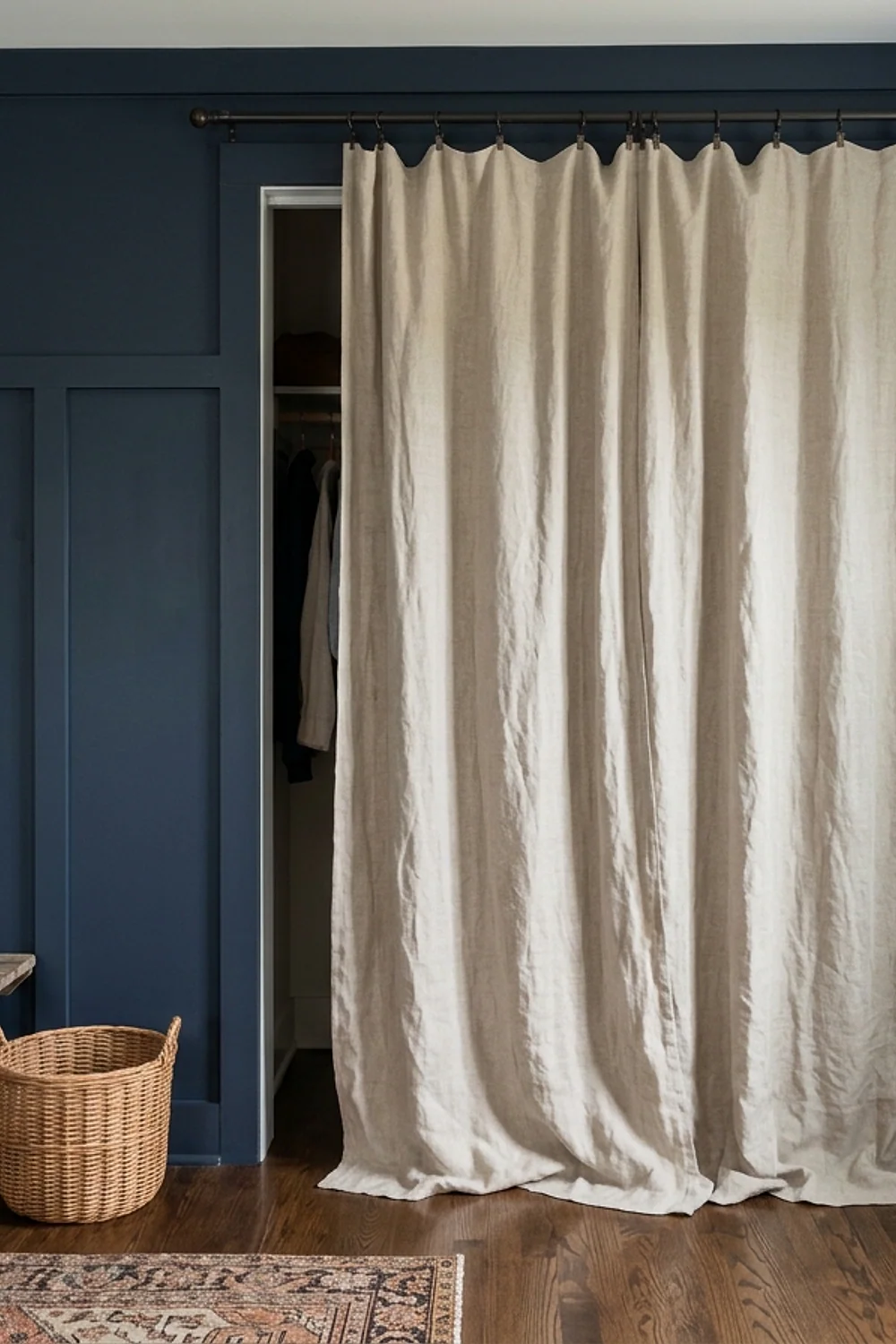
Spring-clip rings on a tension rod give renters a closet cover with zero drilling. Sixteen clips hold a 60-inch panel with even folds. Clips spread the weight along the whole top edge, so the fabric hangs in regular pleats rather than sagging between hooks.
It suits anyone with a strict lease and a missing closet door. The limit is weight: a tension rod holds about 15 pounds, so skip heavy lining. Also tighten the rod snugly between solid walls, since a loose one slips when the panel is pulled aside daily.
26. Oatmeal with a faint gray undertone for cool-painted rooms

Walls in pale blue or sage clash with yellow-leaning linen. A gray-leaning oatmeal reads as neutral and keeps the palette quiet. The gray in the fabric echoes the cool paint instead of fighting it, so neither color looks dirty.
This suits bedrooms, bathrooms and living rooms painted in cool tones. Hold the fabric against the wall at 10am daylight, not under a lamp. Artificial light hides the undertone that shows up by the next afternoon. Order a swatch large enough to drape, about a foot square.
27. A rod that carries the weight of lined linen

A 1-inch rod with a center support bracket handles up to 20 pounds per panel. A cheap 5/8-inch rod bows in the middle within weeks, and once bent it never fully straightens. Lined linen is dense, so the weight pulls hardest at the center of the span.
The mistake is buying beautiful linen and cheap hardware. Spend $30-40 on a rod rated for the load, especially on spans over 60 inches. Wide living room windows and lined panels need this most, while a short unlined pair can get by with less.
28. A contrast ribbon band along the leading edge
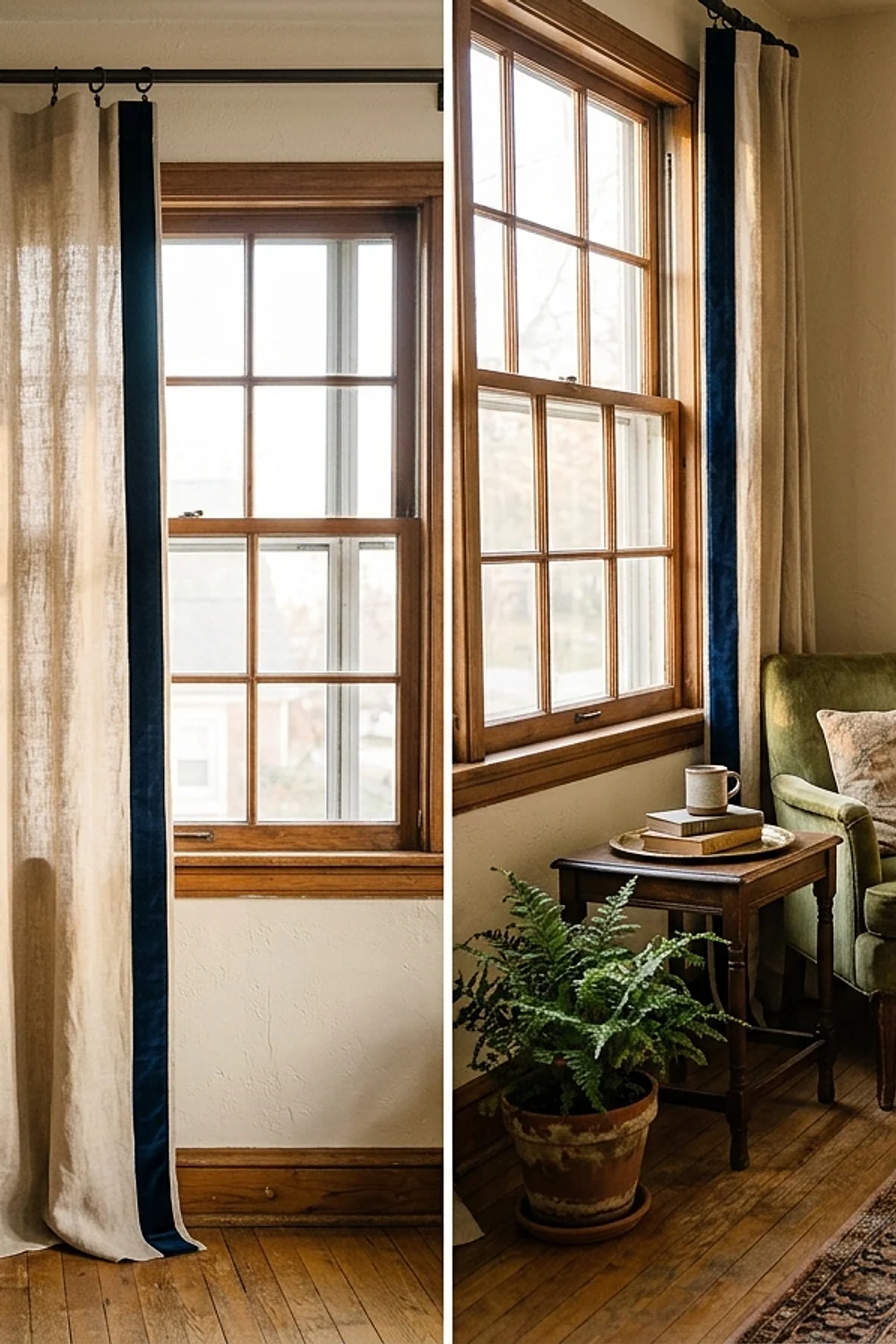
A 2-inch band of navy or charcoal twill sewn to the leading edge outlines each panel and draws the eye up and out. It makes plain oatmeal look tailored without adding bulk. The dark line gives the soft fabric a defined edge, much like a frame around a print.
It suits anyone comfortable with a basic sewing machine or iron-on hem tape. Keep the band narrow, because anything wider than 3 inches shortens the panel visually. Pre-wash the twill too, so it does not shrink away from the linen.
Design inspiration and ideas
Natural linen curtains ideas stack well, but each addition costs a few inches of wall or a bit of light. Pick two or three per window and leave the rest.
A pairing that works in most small rooms:
- A rod 6 inches above the frame and 8 inches wider on each side
- Oatmeal panels at 1.5x fullness, hung half an inch off the floor
- Clip rings with a wand set at chest height
- A white roller shade or removable liner for privacy and sleep
The mistakes below show up again and again. Each one is quick to fix before the next wash.
- Panels too short, ending an inch above the floor and looking like hand-me-downs
- Pleats forced flat, which wastes the fabric
- A thin rod under heavy linen, which sags
- Hot-water washing, which shrinks flax 3-5 percent in one cycle
Wash linen cold, hang it damp from the rod, and steam out creases. Wrinkles are part of the look, so don’t chase a pressed finish.
Start with one window
Natural linen curtains ideas succeed in a small apartment when the hardware is sturdy, the length is right, and the panels are easy enough to use every day. Choose the idea that fixes your most annoying window first, then repeat the formula in the next room.
Save or pin this list so it’s ready when you start shopping. Before you buy anything, measure from 6 inches above the frame to half an inch off the floor, and try item 1 first.
Frequently asked questions
How much fabric do natural linen curtains need for a small window?
Plan on 1.5 times the width of the window for a relaxed ripple. A 36-inch window needs about 54 inches of total panel width, split across two panels. Going to 2x adds bulk that most small rooms can’t spare.
Are natural linen curtains ideas practical for renters?
Yes, because most of them need only a tension rod or an adhesive hook. Clip rings and a rod that sits in existing bracket holes leave no new damage. Hardware costs about $25-40 and moves with you.
Will linen curtains block enough light for sleeping?
Linen alone won’t, since even thick flax lets daylight through. Clip a blackout liner behind it on the same rings and the combination blocks nearly all light. Take the liner off in summer if you want the soft glow back.
How do I stop linen curtains from shrinking or looking wrinkled?
Wash them cold on a gentle cycle and hang them damp on the rod so gravity pulls out most creases. Pre-washing before you hem avoids a shrunken surprise. For natural linen curtains ideas to look relaxed instead of sloppy, steam only the leading edge.